

Emergency ID Options
Table of Contents
- Why Emergency ID Options Matter for People at Risk of Wandering
- What to Put on an Emergency ID Card
- First Responder Information That Changes the Outcome
- Medical ID Bracelets: What They Do Well and What They Miss
- How a Personalised Emergency Profile Works
- Scan2Connect Keyring, Iron-On Patches and the Wanderer Tee
- Comparing Emergency ID Options Side by Side
- Conclusion
- Frequently Asked Questions
Last Updated: October 20, 2026
Why Emergency ID Options Matter for People at Risk of Wandering
Emergency identification options for people at risk of wandering, including autistic people, those with dementia or Alzheimer's, people with Down syndrome or other disabilities, and runners, are wearable or carryable tools that tell a stranger, a paramedic or a police officer who someone is and how to help them, without relying on speech. For a person who can't explain themselves in a crisis, that difference is enormous.
Here's what most guides get wrong. They treat identification as a label problem, like you just need a name tag. It isn't. The real problem is that in an emergency, the person who finds them has no idea what they're dealing with. They see someone who looks like they should respond normally. They expect a typical response. And when that doesn't come, things go badly.
Below, we'll walk through the emergency ID options worth considering and what each one actually does well.
What to Put on an Emergency ID Card
An emergency ID card should carry the person's name, a clear statement of their condition and how it may affect their response to a stranger, emergency contacts, key medical information, and simple instructions for calming them down.
Most cards get this half right. They list a name and a phone number and stop there. That's a label, not a plan.
What we'd put on a card:
- The person's name and a recent photo
- A short line about their condition and what it means, for example: "Autistic. May not respond to speech. Please be patient," or "Has dementia. May be confused and not know their address."
- Two emergency contacts with clickable numbers
- Allergies, medications, seizure history if relevant
- What actually helps: quiet space, no touching, a favourite item, a specific phrase
The last one matters more than people realise. A stranger who knows to stop talking and give space will get a much better outcome than one who keeps asking questions.
First Responder Information That Changes the Outcome
First responder information is the context that stops a misunderstanding turning into a crisis for autistic people, people with dementia or Alzheimer's, people with Down syndrome, and runners. It tells police, ambulance officers and emergency services what behaviour is communication rather than non-compliance.
This is the part I'd shout from the rooftops if I could. Many autistic adults don't make eye contact, don't answer questions, and may pull away when touched. People with dementia, Alzheimer's or Down syndrome can show their own version of this: confusion, repetition, or going quiet under pressure. To an untrained person, any of this reads as evasive or aggressive. It isn't.
Good first responder information covers:
- Communication style: non-speaking, limited speech, or uses a device
- Whether the person understands instructions
- Flight risk, and what they tend to do when overwhelmed
- Sensory triggers such as noise, lights or crowds
- A contact who can confirm identity and calm the situation
Australia's emergency services do have guidance on supporting people with disability during incidents, and it's worth reading what your state's service publishes before you need it. The Australian Institute of Health and Welfare disability data is also useful background on how common communication disability actually is.
The thing nobody tells you: the information has to be readable in seconds, by a stressed stranger, in bad weather. Long paragraphs don't work. Short, blunt lines do.
Medical ID Bracelets: What They Do Well and What They Miss
Medical ID bracelets for autism, dementia or Alzheimer's, Down syndrome and runners are engraved or printed bands worn on the wrist. They do one job extremely well: they survive everything and they're always on the person.
That's genuinely valuable. A bracelet doesn't get left in a bag or taken off in frustration. It's waterproof, it doesn't need charging, and it doesn't depend on anyone scanning anything.
Where they fall short is space. A bracelet holds maybe three or four lines of text. That's enough for a name, a condition and one phone number. It is not enough to explain that Ryan needs his earmuffs, hates being touched, and will bolt towards water.
There's also the wearability question. Plenty of autistic adults, and some people with dementia, Alzheimer's or Down syndrome, can't tolerate anything tight on the wrist. If the bracelet comes off, it's not identification anymore.
So bracelets work as a backup. They don't work as the whole plan.
A Scan2Connect QR profile fills that gap. It holds far more than a bracelet can, and it helps new support staff or carers get up to speed fast during a changeover.
How a Personalised Emergency Profile Works
A personalised emergency profile is a secure webpage holding the full picture: photo, medical details, emergency contacts, communication needs and calming strategies, reached by scanning a QR code. It's the difference between a label and a full briefing.
I Wander Scan2Connect QR Safety Tee for Dementia & Autism →

Here's how ours works. You buy a Scan2Connect subscription, and we build and maintain a private page for the person. When someone scans the code, that page opens on their phone. No app, no login, no battery to worry about.
What goes on the profile:
- A current photo and the person's name
- Medical conditions, medications and allergies
- Emergency contacts that dial with one tap
- Communication methods and AAC symbols
- Calming strategies and what to avoid
The subscription includes four free updates a year, so when things change, the page changes with them. We handle the editing. You just tell us what's different.
The profile can be bought on its own, too. Plenty of families print the QR code onto changeover folders, school communication books and medical bags. It's also handy during support staff changeovers and for new carers, who can scan the code and get up to speed on the person in moments rather than working through old notes. That's the beauty of it being a code rather than a product.
Scan2Connect Keyring, Iron-On Patches and the Wanderer Tee
Our Scan2Connect range puts the same personalised profile on whatever the person will actually wear or carry. The keyring clips to a backpack. The iron-on patch goes on a school uniform. The Wanderer Tee carries the code on the back where a stranger will see it.
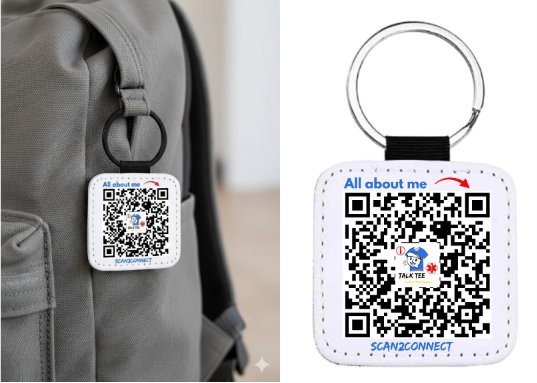
The Scan2Connect Keyring is the one I'd start with for an adult who won't wear anything unusual. It measures 5cm square excluding the ring, comes in sets of two or three, and clips onto keys, bags or a medical bag without a second glance. Nobody questions a keyring.
The Scan2Connect Iron-On Patch is 6.5cm square and goes straight onto existing clothing: school uniforms, jackets, hats, sports bags. Heat, press, bond. No new wardrobe required.
The I Wander Scan2Connect QR Safety Tee is our wanderer shirt. It says "I Wander" on the front and carries the message "If I look lost, I probably am" on the back, with the QR code linking to the profile. It's 100 per cent cotton, tag free, and comes in adult and children's sizes. We made it with dementia and Alzheimer's in mind as much as autism and Down syndrome, because a runner is a runner. If your adult child is a bolter, this is the one that works from a distance, when nobody is close enough to read a bracelet.

I Wander Scan2Connect QR Safety Tee
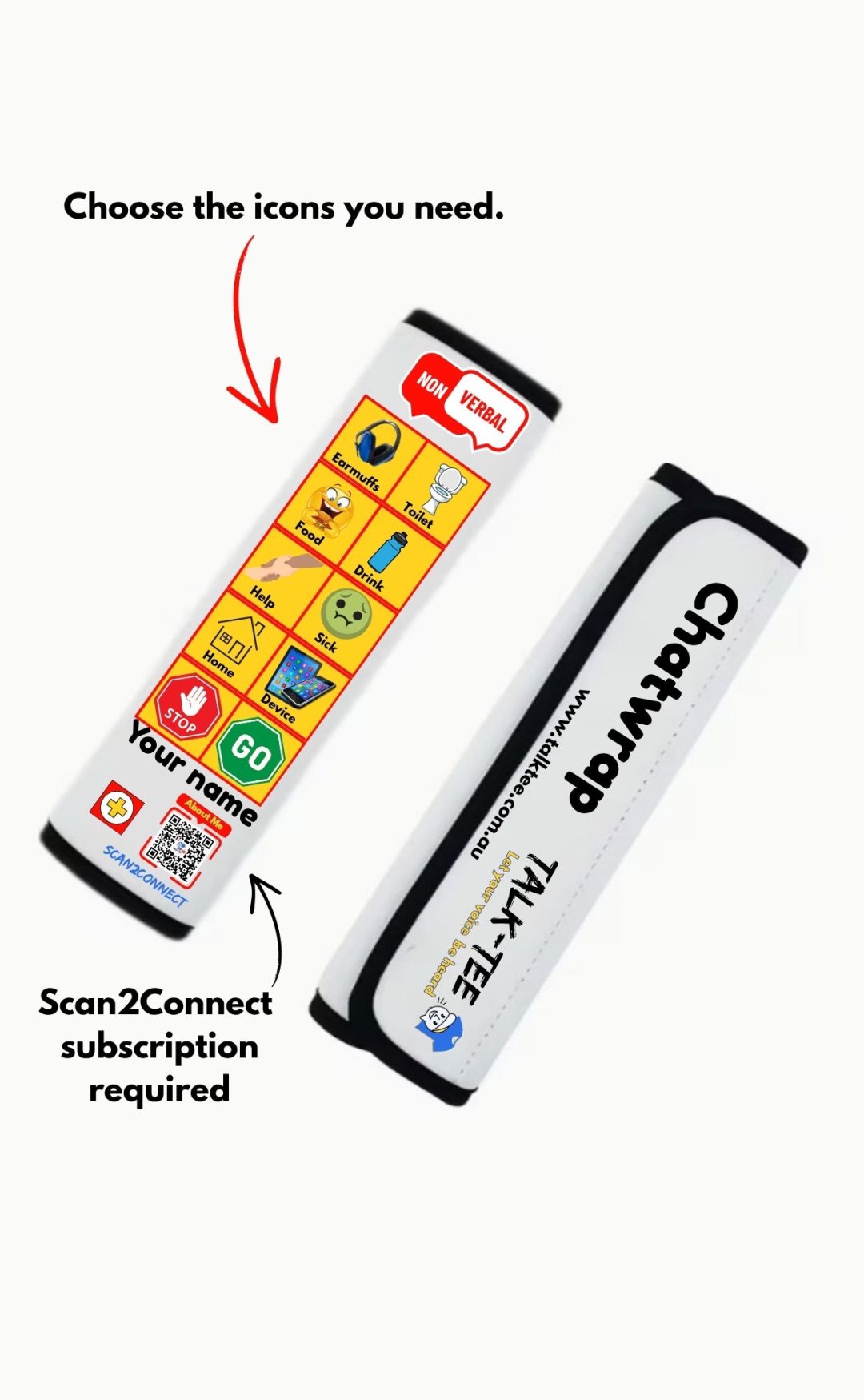
The Seatbelt Chat-Wrap attaches to any seatbelt or harness with velcro, shows the wearer's name and a NON VERBAL badge, and carries a customisable AAC symbol grid alongside the QR code. It's designed for the car, where a lot of distress happens.
Comparing Emergency ID Options Side by Side
Every option here works. They work differently, and the right choice depends on whether the person will wear it, how much information a stranger needs, and whether you need it readable from across a room.
Option |
What it carries |
Best for |
Main limitation |
|---|---|---|---|
Medical ID bracelet |
Name, condition, one contact |
Constant wear, no tech needed |
Very little detail, sensory issues |
Emergency ID card |
Written details, contacts |
Wallet or communication folder |
Easily lost, needs to be found |
Full QR profile |
Adults who won't wear special clothing |
Needs a phone to scan |
|
Scan2Connect Iron-On Patch |
Full QR profile |
School uniforms and existing clothing |
Requires ironing on |
I Wander Scan2Connect Tee |
Full QR profile, visible message |
Wanderers and flight risk |
Only worn when dressed |
Seatbelt Chat-Wrap |
QR profile plus AAC symbols |
Car travel and harnesses |
Vehicle-specific |
If you want one clear recommendation: start with a QR profile, because it holds everything and updates as life changes. Then put it on the item the person will actually keep with them. The NDIS assistive technology guidance is worth checking if you're exploring funding for communication and safety aids.
Conclusion
The hard part isn't choosing an option. It's accepting that someone you care about, whether that's an autistic adult child, a parent living with dementia or Alzheimer's, a person with Down syndrome, or a runner who trains alone, may one day need a stranger to know things they can't say themselves, and preparing for that before it happens.
At Talk-Tee, we build the Scan2Connect personalised profile around exactly that moment: a secure page with a photo, medical details, emergency contacts and calming strategies, reachable by anyone with a phone. It also helps support staff changeovers and new carers get up to speed on the person quickly. Add the Keyring for everyday carry, the Iron-On Patch for school and sports gear, or the I Wander Tee for a wanderer who needs to be spotted from a distance.

Get started with Talk-Tee and give the people who find them everything they need in one scan.
Frequently Asked Questions
What should an emergency ID card include for someone at risk of wandering or unable to communicate?
Keep it short and practical: the person's name, a clear note about why they may not speak or respond to questions, for example autism, dementia, Down syndrome or another disability, emergency contacts with phone numbers, key medical information such as allergies or medication, and calming strategies that actually work. Add a line about how they communicate, for example pointing, a device, or key word signing. Anything longer than a credit card gets skipped in a hurry, so put the essentials on the card and let a QR code carry the rest.
Are medical ID bracelets useful for autistic adults, people with dementia or other disabilities?
They help when the person will wear one and when the information is medical, such as epilepsy, diabetes or a medication allergy. The limit is space: a bracelet holds a few lines at most, and many autistic adults, people with dementia and others find metal or tight bands uncomfortable and take them off. If a bracelet is refused, a keyring, iron-on patch or printed tee keeps the same information available without touching the wrist.
Can a QR code work for emergency information for autistic people, runners or people with dementia?
Yes, and it is one of the easiest options for anyone who can't explain themselves under pressure, whether that's an autistic person, someone living with dementia or Alzheimer's, a person with Down syndrome, or a runner training alone. A personalised emergency profile behind a QR code can hold medical details, emergency contacts, communication methods and calming strategies, and a smartphone scan opens it in seconds. Talk-Tee's Scan2Connect profile can be bought on its own as an annual subscription and printed onto changeover folders as well as clothing.
How can someone who is non-verbal communicate in an emergency?
Give the people around them something to read. A card, a keyring or a QR profile that states the person is non-verbal and lists what they need removes the guessing, whether that's due to autism, dementia or another condition. Pair it with a small set of AAC symbols for help, stop, sick and home. The Seatbelt Chat-Wrap does this on a seatbelt or harness, showing a NON VERBAL badge, the wearer's name and a customisable icon grid alongside the Scan2Connect code.
How do I choose between an ID card and a medical ID bracelet?
Start with where the person goes and who is likely to find them. A card in a wallet or bag suits everyday independence but disappears if the bag is lost. A medical ID bracelet stays on the body but holds little detail. A QR profile on clothing or a keyring sits in between: visible, hard to leave behind and able to carry a full history. Many families use two together, a card for daily use and a QR item for outings.