

Low-Tech Communication Aids for Autism: A 2026 Guide
Table of Contents
- What Are Low-Tech Communication Aids for Autism?
- Low-Tech AAC Examples That Work in Real Settings
- Understanding AAC Communication Boards
- How to Use AAC at Home: Practical Implementation
- Low-Tech AAC vs High-Tech AAC: Which Is Right?
- Choosing the Right Low-Tech Communication Aid
- NDIS Funding and Accessibility
- Frequently Asked Questions
Last Updated: 8 October 2026
What Are Low-Tech Communication Aids for Autism?
Low-tech communication aids are non-electronic tools that help non-verbal individuals and those with speech delays express themselves without batteries, charging, or technical setup.

For children and adults with autism, apraxia of speech, or other communication challenges, low-tech aids fill a critical gap.
At Talk-Tee, we've designed wearable communication solutions that put essential symbols directly on clothing, making communication portable and hands-free.
Low-Tech AAC Examples That Work in Real Settings
Augmentative and Alternative Communication (AAC) is the formal term for any method that supplements or replaces spoken language. Low-tech AAC examples are the practical tools that make this work in everyday life.
Picture and Symbol Cards
Picture cards and symbol systems use images to represent words, actions, or concepts. A user points to or touches the card matching what they want to communicate.
The strength of picture cards is flexibility: you can customise them to match the person's interests, routines, and vocabulary.
The limitation is portability: a full communication board can be bulky, and carrying multiple card sets isn't practical.
Wearable Communication Clothing
Wearable communication clothing combines symbol-based communication with the portability of everyday apparel. Shirts, hoodies, and other garments feature printed symbols or words others can see and understand, with no separate device to carry or manage.
Talk-Tee's range includes options designed for different communication needs. The Dots Low-Tech Communication Board T-Shirt features eight essential communication symbols arranged in a clear, visual layout with "I Need" at the centre, surrounded by bubbles for Help, Food, Drink, Rest, Device, Jumper, Toilet, and Earmuffs.
For individuals who communicate through spelling, the Spelling-TEE includes the complete alphabet and numbers 0-9, allowing users to spell out words and messages. For those who benefit from stick-figure symbols representing emotions and actions, the Sticky-TEE provides 20 essential symbols in bright, eye-catching colours.

The advantage of wearable communication clothing is that it's always accessible, nothing to lose, forget, or carry separately.
Gesture and Sign Systems
Not all low-tech communication relies on visual symbols.
Some people develop idiosyncratic gestures that family members and regular caregivers learn to recognise; others benefit from structured systems like Makaton, which combines signs, symbols, and spoken words.
The challenge is that gesture-based systems require others to learn the meanings, a gesture clear to a family member might not be understood by a teacher, doctor, or stranger.
Understanding AAC Communication Boards
An AAC communication board is a structured display of symbols, words, or pictures arranged so the user can quickly locate and indicate what they want to communicate. Boards range from a laminated sheet of printed images to a custom grid built around an individual's vocabulary and communication patterns.
Fixed Boards vs Customisable Options
Fixed boards come pre-printed with a standard set of symbols or words. They're ready to use immediately, require no setup, and are cost-effective, but may not match the individual's specific needs or vocabulary.
Customisable boards let you add, remove, or rearrange symbols based on the person's goals and interests, updating them as needs change. This flexibility suits children whose communication evolves and adults whose routines shift by season or context.
Talk-Tee's wearable options sit in a middle ground: pre-designed with carefully chosen symbols covering the most common needs, yet specific enough to be immediately useful without customisation. The Dots Low-Tech Communication Board T-Shirt and Dots AAC Hoodie share the same symbol selection, giving families a consistent tool across seasons and contexts.

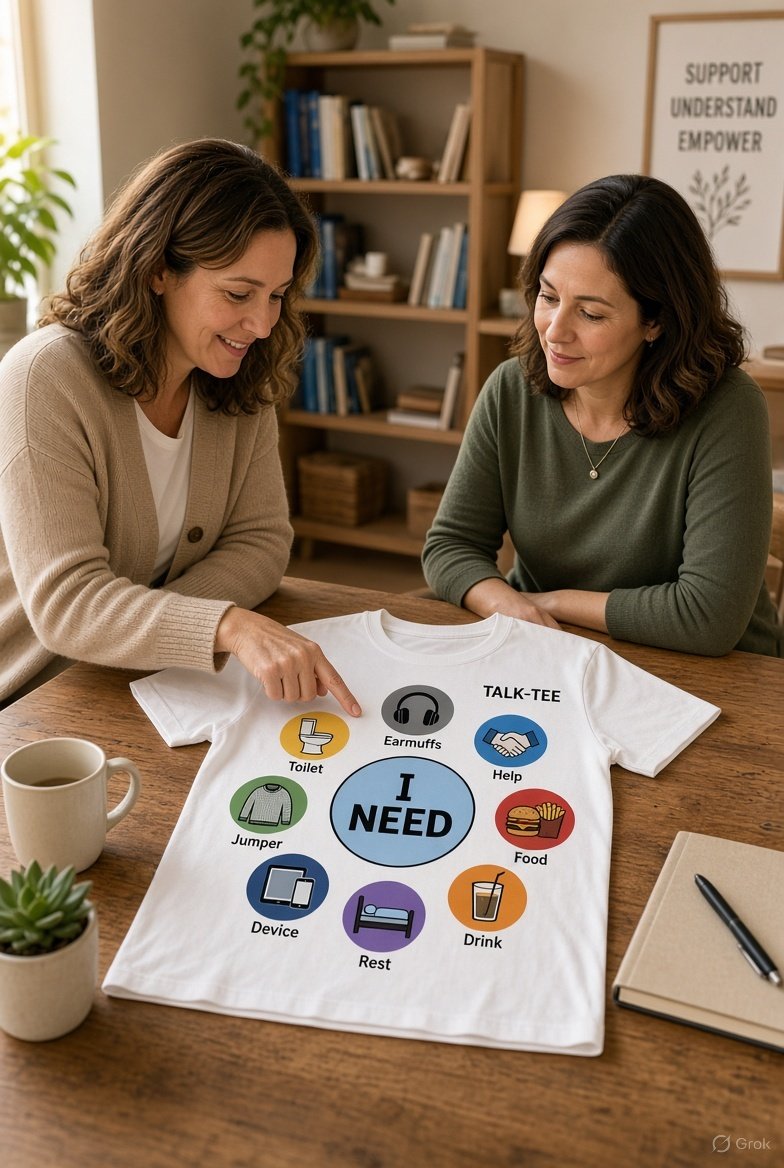
What to Include in an Effective Board
The most effective communication boards include:
- Core vocabulary: high-frequency words like "yes," "no," "help," "more," "stop"
- Immediate needs: food, drink, toilet, rest
- Social words: hello, goodbye, please, thank you
The principle is enough vocabulary for meaningful communication without overwhelming the user. Research into AAC use shows people are more likely to use boards that are simple and visually clear, with symbols large enough to see and point to easily.
How to Use AAC at Home: Practical Implementation
Introducing a low-tech communication aid at home takes more than having the tool available. It works best when it becomes part of the daily routine and everyone in the household understands how to use and respond to it.
Parent and child using wearable communication shirt with symbols during mealtime at home, pointing to food-related icons on the shirt, natural kitchen lighting
Creating a Communication-Friendly Environment
Start by identifying when communication breakdowns happen most often, transitions, meals, bedtime routines. These are the moments a communication aid makes the biggest difference.
Place the tool where it's visible and accessible. If using a communication shirt like Talk-Tee's Dots or Sticky-TEE, wear it during these high-communication moments.
Model how to use the tool by pointing to symbols yourself.
Building Consistency Across Settings
Communication aids work best used consistently across home, school, and other settings.
Work with teachers, therapists, and other caregivers so everyone responds the same way. If the child points to "Help" on their shirt, all adults should pause, acknowledge the request, and provide support.
Keep a simple log of which symbols the person uses most, which they rarely use, and any new communication attempts. This helps you refine the tool and track evolving needs.
Dots Low-Tech Communication Board T-Shirt →
Low-Tech AAC vs High-Tech AAC: Which Is Right?
The choice between low-tech and high-tech communication aids isn't always either-or. Many families use both, depending on the situation and the person's needs.
Speed and Accessibility Comparison
Low-tech aids are typically faster to access. A person wearing a communication shirt can point to a symbol immediately. There's no screen to unlock, no app to open, no lag time.
High-tech AAC devices, tablets or dedicated speech-generating devices, offer more vocabulary and can produce spoken output, which some people find more socially acceptable. However, they require charging, can malfunction, and may not be available in all situations.
Cost and Maintenance Considerations
Low-tech solutions are significantly less expensive upfront. A Talk-Tee communication shirt costs around $34.95 to $79.95. There's no software to update, no subscriptions, and minimal maintenance beyond occasional washing.
High-tech devices require ongoing costs for software updates, repairs, and replacement parts. They're also more fragile, a dropped tablet or damaged screen can take the device out of commission until it's repaired.
Using Both Together for Maximum Benefit
Many families find that combining low-tech and high-tech approaches works best. A child might wear a Talk-Tee communication shirt for quick, everyday communication and use a tablet-based AAC app when they need more vocabulary or want to generate speech for social situations.
The low-tech tool serves as a backup when the high-tech device isn't available and provides a consistent, always-accessible communication option. This combination approach reduces frustration and ensures the person has a way to communicate regardless of circumstances.
Choosing the Right Low-Tech Communication Aid
Selecting the right tool depends on understanding the individual's communication style, sensory needs, and practical constraints.
Assessing Your Child's Communication Style
Does the person respond better to pictures, symbols, letters, or words? Some individuals understand photographs more readily than abstract symbols.
Consider their motor skills and pointing accuracy. Can they reliably point to small symbols, or do they need larger targets?
Think about their vocabulary and communication goals. The Spelling-TEE suits individuals who can spell or who benefit from letter-based communication.
Considering Sensory and Practical Needs
Some individuals are sensory-sensitive and may resist wearing clothing with printed designs. Observing their reactions to different textures, colours, and visual patterns helps.
Consider the practical context. Will the tool be used primarily at home, at school, or in the community?
Think about social acceptance. Some individuals feel self-conscious about visible communication aids. Others don't mind. Involving the person in the choice, if they're able to express a preference, increases the likelihood they'll use the tool consistently.
NDIS Funding and Accessibility
In Australia, assistive technology and communication aids may be funded through the National Disability Insurance Scheme (NDIS) if they're included in an individual's plan.
To access NDIS funding for a communication aid, the need must be documented in the person's plan, and the device or tool must be recommended by a speech pathologist, therapist, or other qualified professional.
If you're an NDIS participant, discuss communication aids with your planner or support coordinator.
Talk-Tee's communication clothing is designed to be affordable and accessible, making it a practical option whether or not NDIS funding is available.
Choosing a low-tech communication aid is about finding the right fit for the person's needs, not about having the most advanced technology. Talk-Tee's wearable communication solutions, including the Dots Low-Tech Communication Board T-Shirt, Dots AAC Hoodie, Spelling-TEE, Sticky-TEE, and First-Then-Next AAC Tee, put communication symbols where they're needed most: always accessible, never forgotten, and integrated into everyday clothing.
Frequently Asked Questions
What are low-tech communication aids for autism?
Low-tech communication aids are simple, battery-free tools that help non-verbal or minimally verbal autistic individuals express themselves. Examples include picture cards, communication boards, wearable clothing with symbols, and gesture systems. Unlike high-tech devices, they require no charging, software updates, or technical support—making them instantly accessible anytime, anywhere. They work by using visual symbols, pictures, or written words that users point to or touch to communicate their needs, feelings, and ideas.
What are examples of low-tech AAC?
Common low-tech AAC examples include laminated picture cards, communication boards with symbols arranged by category, wearable communication clothing with printed symbols or words, alphabet charts for spelling, gesture and sign systems, and written word lists. Wearable options like the Dots Low-Tech Communication Board T-Shirt ($34.95) put essential communication symbols directly on clothing—featuring 'I Need' in the centre surrounded by bubbles for help, food, drink, rest, device, jumper, toilet, and earmuffs. These tools work across settings without maintenance or batteries.
Can low-tech and high-tech AAC be used together?
Yes, many users benefit from combining both approaches. A child might use a low-tech communication board at home or in noisy environments where a high-tech device would be difficult to hear, then switch to a speech-generating device in quieter settings or for more complex conversations. Low-tech tools serve as backups when high-tech devices run out of battery or malfunction, and they often introduce communication concepts that make high-tech devices easier to learn. Working with a speech therapist helps determine the best combination for your situation.
How do I choose a communication aid for an autistic person?
Consider the person's visual processing abilities, fine motor skills, and communication needs. Some prefer picture symbols, others respond better to words or letters. Think about where communication happens most: at home, school, or in the community. Assess sensory sensitivities—some autistic individuals may prefer clothing-based systems over carrying cards. Budget matters too; low-tech options start around $34.95 for wearable communication clothing. Involve the person in testing different options when possible, and consult a speech therapist or educator for personalised recommendations based on their communication style.
Do picture cards stop an autistic person from learning to speak?
No. Research and practice show that providing communication tools does not reduce speech development. In fact, AAC often supports speech development by reducing frustration and giving the person a way to communicate while they're learning or developing speech skills. Many autistic individuals use both AAC and spoken words together. The goal of AAC is to give people a voice now, not to replace natural speech. It removes the pressure to speak before they're ready and allows communication to happen at their own pace.
How do you use a communication board at home?
Start by placing the board where it's visible and accessible during daily routines like meals, playtime, and transitions. Point to symbols yourself when offering choices ('Do you want juice or water?') so the person learns how the board works. Respond immediately and enthusiastically when they point to symbols—this reinforces that communication works. Use the same board consistently across different rooms and times of day. Keep it at eye level and make sure lighting is good enough to see symbols clearly. Involve other family members so communication stays consistent whether you're present or not.
Is low-tech AAC covered by NDIS funding?
Many low-tech AAC tools are eligible for NDIS funding if they're listed as assistive technology supports in your participant plan. Coverage depends on your individual plan and goals. Communication aids, including wearable options and custom boards, may be funded under 'Assistive Technology' or 'Communication and Mobility Equipment' categories. Check your plan documents or contact your NDIS planner to confirm what's covered. Some families find that starting with affordable low-tech options like the Dots AAC Hoodie ($79.95) or Dots Low-Tech Communication Board T-Shirt ($34.95) works alongside NDIS-funded solutions.
What should I include in a basic communication board?
A basic board needs words or symbols for immediate needs: food, drink, toilet, help, yes, no, more, stop, and rest. Add words for people in their life (mum, teacher, friend) and key activities (play, sleep, school). Include a way to express feelings: happy, sad, tired, angry. Many boards use the 'I Need' format as a central hub with categories branching outward. Start simple—too many options overwhelm. The Dots Low-Tech Communication Board T-Shirt includes eight essential categories around a central 'I Need' hub, providing a proven starting point that covers the most-used communication needs.