

Wearable Communication Tools for Nonverbal Children
Table of Contents
- Why Wearable Communication Tools for Nonverbal Children Stay Within Reach
- Low-Tech AAC Examples You Can Wear
- How to Choose an AAC Device or Tool for Your Child
- AAC Tools for Autistic Children: Matching the Tool to the Child
- From Picture Communication Cards for Children to a Shirt They Will Actually Wear
- Getting Started: Wearing, Teaching and Keeping the Tool in Use
- Conclusion: A Voice That Travels With Them
- Frequently Asked Questions
Last Updated: October 9, 2026
Why Wearable Communication Tools for Nonverbal Children Stay Within Reach
Wearable communication tools for nonverbal children are communication aids built into everyday clothing and accessories, so a child's voice travels with them instead of sitting in a bag. At Talk-Tee, we design low-tech AAC apparel for exactly this reason: a tool that is worn gets used.
That distinction matters more than most guides admit.
Traditional picture cards and bulky speech devices work well in a therapy room. Clothing removes that barrier. There is nothing to carry, charge, or remember.
Below, we break down the low-tech AAC examples worth knowing, how to choose an AAC device or tool, and how to build a routine that keeps it in use.
Low-Tech AAC Examples You Can Wear
Low-tech AAC examples range from printed symbol boards to wearable clothing, and the wearable versions all share one advantage: the tool is already on the body. A low-tech AAC system needs no battery, no software, and no setup.
Wearable options fall into three broad groups:
- Symbol t-shirts with a grid of icons printed on the front
- Caps with hidden icon panels tucked under the peak
- QR-linked clothing that connects to a personal safety page
Each suits a different child and a different situation.
T-Shirt Communication Boards
A t-shirt communication board prints a symbol grid directly onto the fabric. The child points, and the adult reads.
The Sticky-TEE carries 20 stick figure symbols in bright coloured boxes. These cover personal words, actions, emotions, responses, and essentials like food and toilet. It costs $34.95 and comes in men's, women's, and children's sizes.
For a wider spread of needs and feelings, the Freedom AAC-TEE uses a device-style layout with 20 images including toilet, food, drink, stop, help, sick, tired, and happy. Same price, same size range.

Older children who spell may prefer the Spelling-TEE, which prints the full alphabet and numbers 0-9 across the front.
Caps With Hidden Icon Panels
A cap with a hidden icon panel keeps symbols out of sight until they are needed. The child removes the cap, and the icons appear.
The Chat-Cap Essentials holds 21 icons under the peak, printed in a style most people already recognise from their phone. The Chat-Cap Action uses 21 stick figure action icons instead, covering words like stop, look, more, help, and want.
Both use an adjustable closure, so they fit a range of head sizes. The Essentials is $39.95. The Chat-Cap Core and Chat-Cap Action versions are $15.00.
How to Choose an AAC Device or Tool for Your Child
Choosing comes down to four questions: what does your child already understand, what will they tolerate wearing, who needs to read it, and where will it be used. Answer those before you spend anything.
Work through this checklist:
- Does your child recognise photos, line drawings, or written words?
- Will they wear a t-shirt, a cap, or neither?
- Do strangers need to understand the symbols, or only familiar adults?
- Is the main setting school, home, community outings, or all three?
- Does the child need to express needs, answer questions, or spell?
- Is emergency identification part of the goal?
Match the answers to the tool type. A child who points at pictures but will not wear a hat needs a t-shirt. A teenager who wants nothing visible needs a hidden panel.
Speech and language therapists can help here. An assessment will show which symbol style your child reads most easily.
AAC Tools for Autistic Children: Matching the Tool to the Child
AAC tools for autistic children work best when they match sensory needs and communication style, not when they match a catalogue. Some children need predictable routines. Others need choice.
Here is how the common needs line up:
Child's need |
Best tool type |
Why it fits |
|---|---|---|
Points at pictures, dislikes hats |
Symbol t-shirt |
Worn, no head contact |
Needs transitions explained |
Sequencing tee |
Shows first, then, next |
Wants nothing visible |
Hidden-panel cap |
Icons only appear when needed |
Spells or is learning letters |
Alphabet tee |
Full A-Z and 0-9 |
Flight risk or medical needs |
QR-linked tee |
Scannable safety page |
The First-Then-Next AAC Tee suits children who struggle with changes. It prints clock and activity images in a clear grid, so an adult can show what happens now and what comes next.
For safety, the Bubbles Scan2Connect Tee and Echo Scan2Connect Tee add a scannable QR code. It links to a secure personal page holding medical details, emergency contacts, and communication tools. You decide what goes on it. A PDF of the code is included so support workers and schools can keep a copy.

Both cost $34.95, and the first 12 months of the QR subscription are free with purchase.
From Picture Communication Cards for Children to a Shirt They Will Actually Wear
Picture communication cards for children are a solid starting point, but they live in a folder. The folder stays home. The child does not.
That gap is where most communication systems quietly fail.
Wearable tools close it. The symbols are on the body, so nothing needs fetching, opening, or remembering. A child who cannot ask for the toilet at home can point at the toilet symbol at a friend's house, in a car park, or at a birthday party.
There is a second benefit that parents raise often: dignity. A shirt looks like a shirt. It does not look like a medical device or a therapy aid.
Getting Started: Wearing, Teaching and Keeping the Tool in Use
Start small: wear the tool during one routine, teach two or three symbols, and add more only once those are reliable. Most families try to introduce everything at once, and that is the fastest way to get a refusal.
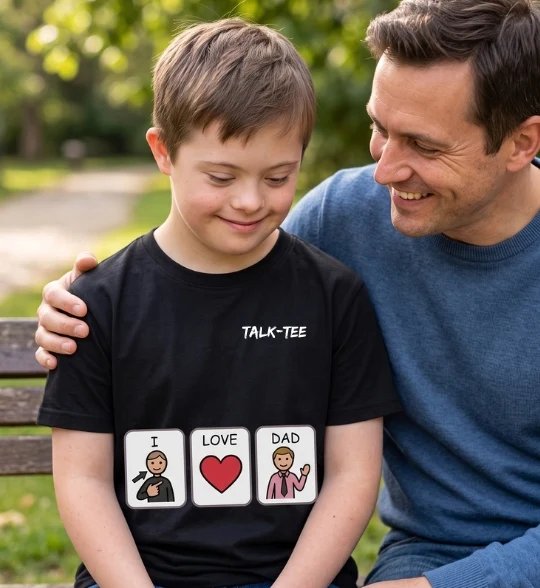
A workable first month looks like this:
- Week one. Wear the tool for ten minutes during a preferred activity.
- Week two. Model two symbols yourself, such as "more" and "stop".
- Week three. Pause and wait. Give your child time to point before you guess.
- Week four. Add one new symbol and use the tool outside the house.
The rule that matters most: always respond when your child uses a symbol. Even if you already knew what they wanted. If pointing at "drink" gets a drink, the tool has value. If it gets nothing, it gets abandoned.
A common mistake is treating the tool as a test. It is not. It is a shortcut to getting needs met, and it has to pay off immediately.
Conclusion: A Voice That Travels With Them
Building a communication routine that survives real life is hard. Tools get left behind, children get frustrated, and progress moves in stops and starts.
Wearable communication apparel removes one of those problems entirely. Talk-Tee makes low-tech AAC clothing with printed symbol grids, hidden cap panels, and optional Scan2Connect QR safety codes that link to a secure personal page. Many of our products are 100% cotton, tag free, and available in children's and adult sizes.
Get started with Talk-Tee and give your child a voice that goes everywhere they go.
Frequently Asked Questions
What communication tools can help a nonverbal child express their needs?
Low-tech options are the quickest to get started with: printed symbol boards, picture cards, and wearable communication tools such as symbol t-shirts and caps with icons printed on them. A shirt like the Sticky-TEE carries 20 stick figure symbols covering wants, actions, feelings, yes/no and essentials such as food and toilet, so the child never has to fetch a device. Many families pair a wearable with a speech-generating device, using the wearable for fast everyday requests and the device for longer messages.
Can clothing really help a child communicate?
Clothing works because it removes the two biggest barriers to AAC use: retrieval and setup. A wearable communication tool is on the body, so there is nothing to charge, open or carry, and no app to load. The child points at a symbol on the front of the shirt, or a supporter points at it and models the word. Caps with icons hidden under the peak, such as the Chat-Cap Essentials with 21 icons, add a discreet option for children who prefer not to draw attention.
How do I choose an AAC device or tool for my child?
Start with what the child needs to say most often and who needs to understand it. If they mostly request food, drink, toilet and help, a small symbol set on a shirt is enough. If they spell or need to name places and people, a full alphabet and number layout such as the Spelling-TEE suits better. Then check the practical details: does the child tolerate the fabric, will they keep a cap on, and can a teacher or support worker read the symbols at a glance.
Are low-tech communication tools useful alongside speech-generating devices?
Yes. They cover different moments. A speech-generating device handles complex sentences and vocabulary building, while a low-tech wearable handles the fast, physical situations where a device is out of reach: in the playground, in the pool changing room, or at the shops. Because low-tech tools need no charging or maintenance, they also keep working when a battery does not. Many therapists use a wearable as the modelling surface during the day and the device for structured sessions.