

How to Integrate AAC Into Daily Outfits
Table of Contents
- Why Wearable AAC Clothing Matters for Daily Communication
- Understanding Wearable AAC Clothing Options
- Choosing the Right AAC Symbols on Clothing for Your Needs
- Styling AAC Clothing for Children: Making Communication Natural
- Building AAC Into Daily Routines and Activities
- Common Mistakes to Avoid When Integrating AAC Into Outfits
- Practical Tips for Success
- Frequently Asked Questions
Last Updated: October 16, 2026
Why Wearable AAC Clothing Matters for Daily Communication
Non-verbal communication doesn't need to wait for the right device or the right moment. When you integrate AAC into daily outfits, you're putting a voice into the clothes your child or client wears every single day.
At Talk-Tee, we've seen families transform their daily routines by choosing wearable AAC clothing. The shift is simple but powerful: communication stops being something you carry and starts being something you wear.
Here's what matters most. Traditional AAC devices require setup, charging, and careful handling. They're tools you remember to bring. Wearable AAC solutions are different. A t-shirt or cap with communication symbols is always there. Your child gets dressed in the morning, and their voice comes with them.
The practical benefits stack up fast:
- Communication stays accessible during play, sports, and messy activities
- No device to lose, drop, or charge
- Hands remain free for other tasks
- Symbols are visible to anyone who needs to understand
- Works in any environment, indoors or outdoors
Research on assistive technology accessibility shows that low-tech solutions like wearable communication tools increase usage rates because they remove barriers to access. When communication is as simple as pointing to a shirt, it gets used more often.
Understanding Wearable AAC Clothing Options
Different communication needs call for different symbol systems. The clothing you choose should match how your child or client communicates best, not force them into a system that doesn't fit.
Some T-Shirt Options: Freedom, Sticky, and Spelling Designs
The Freedom AAC-TEE uses the layout most people recognise from traditional AAC devices. Twenty images arranged in a familiar grid pattern means anyone who's worked with AAC boards will instantly understand the system.

This design works especially well for children transitioning from device-based AAC to wearable solutions. The layout feels familiar. Supporters and teachers already know where to look.
The Sticky-TEE takes a different approach with stick figure symbols in bright coloured boxes. Each symbol is simple and visual.
This option suits children who respond well to bold visuals and bright colours. The symbols feel less formal than traditional AAC layouts.
The Spelling-TEE puts the full alphabet and numbers 0-9 across the chest. This is your option when spelling matters. Children who can spell out words, names, or places get complete communication freedom.
This design works for older children, for educators teaching literacy, and for anyone who needs to communicate beyond a fixed symbol set.
Caps and Accessories for Discreet Communication
Not every situation calls for a full t-shirt. The Chat-Cap Core hides communication symbols under the peak of a cap. Twenty emoji icons stay completely hidden when the cap is worn normally. When communication is needed, the wearer simply removes the cap to show the symbols.
This design solves a real problem. Some young people feel self-conscious about visible communication symbols. They want the tool, but they don't want to broadcast it constantly. A cap that looks like any other cap, with symbols that appear only when needed, gives them control over when their communication is visible.
Emoji symbols are universally recognised. Most people understand what each emoji means without explanation. The cap works in any setting, school, social outings, home, without drawing unwanted attention.
Choosing the Right AAC Symbols on Clothing for Your Needs
The best symbol system is the one your child will actually use. That sounds obvious, but it's where many families stumble.
Start by observing what communication matters most right now. Does your child need to request food and drink constantly? Does behaviour escalate when they can't express emotions? Do they need help asking for the toilet, or is that already managed?
Talk-Tee's range covers the most common communication needs. The Freedom AAC-TEE includes twenty symbols chosen specifically for frequent daily use.
Test the symbols before committing to a full wardrobe. Some families borrow or try one shirt first. Watch which symbols your child points to. Notice which ones their supporters and teachers use.
Consider your child's learning style too. Do they respond to realistic images, simple shapes, or emoji? A child who gravitates toward bright colours might engage more with the Sticky-TEE's coloured boxes than with the Freedom design's neutral layout.

Styling AAC Clothing for Children: Making Communication Natural
A communication shirt is still a shirt. It needs to fit into your child's wardrobe and their daily life, not stand out as medical equipment.
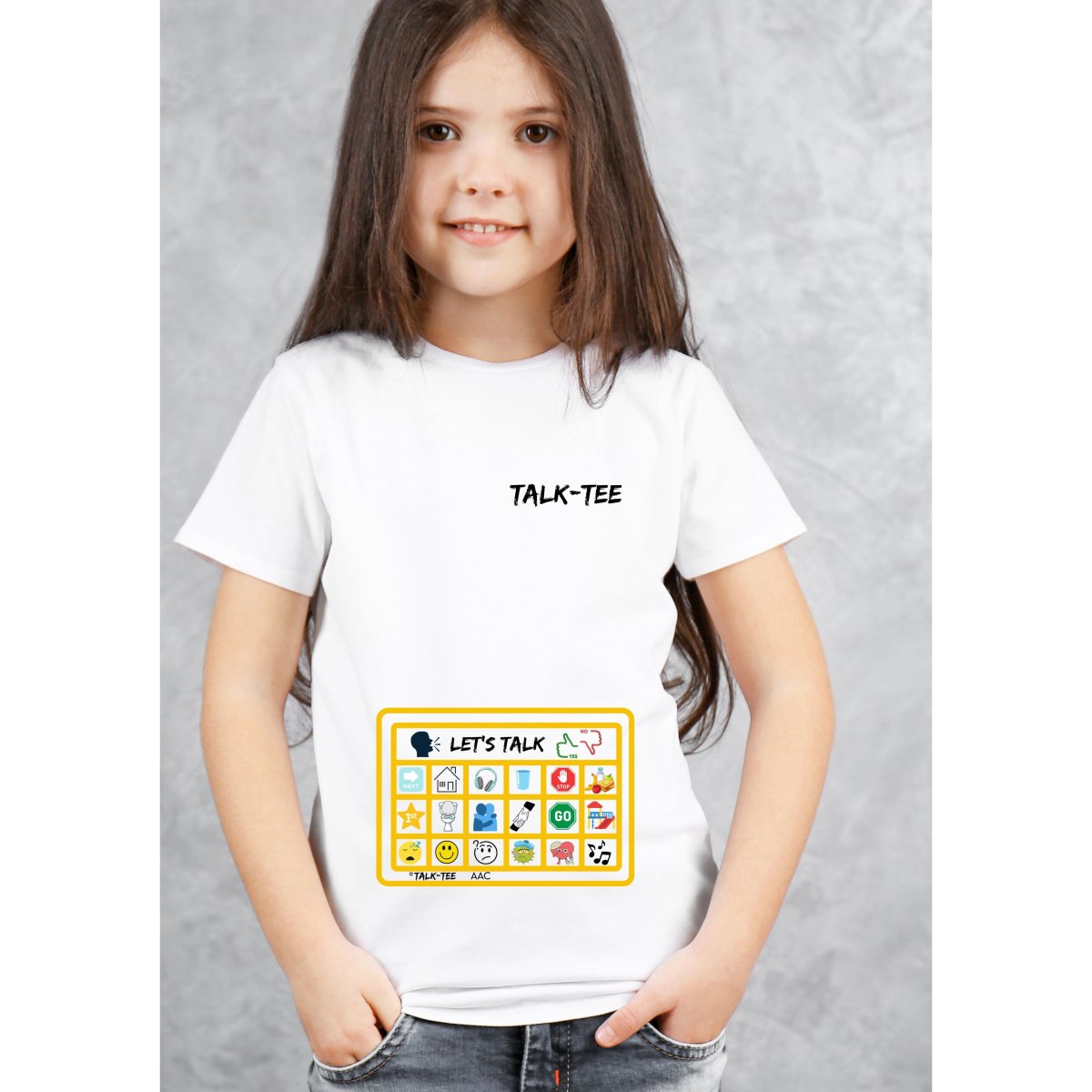
The Freedom AAC-TEE, Sticky-TEE, and Spelling-TEE all come in children's sizes and are made from soft, comfortable cotton. They're designed to work with regular clothes, not replace them.

The goal is to make the shirt feel like a normal part of getting dressed, not a special accommodation.
Rotation helps. Having two or three AAC shirts in your child's drawer means one is always clean and ready. They can choose which one to wear, which builds ownership.
The Chat-Cap Core works the same way. It's a normal cap that happens to have communication symbols hidden underneath. Your child wears it because they like caps, not because it's assistive technology.
Involve your child in the choice if you can. Let them pick the size, see the colours, feel the fabric.
Building AAC Into Daily Routines and Activities
Communication tools only work if they're part of your daily life. Integration means the shirt or cap becomes as routine as breakfast.
School and Classroom Settings
Teachers and support staff need to know the symbols are there. A quick conversation before school starts makes all the difference. Show them which symbols your child uses most. Explain that the shirt is a communication tool, not a behaviour management device. The goal is for your child to point and be understood, not to punish or reward symbol use.
Some children use the shirt as their primary communication at school. Others use it as a backup when the day gets overwhelming. Either way, consistency matters. If your child wears an AAC shirt on Monday but not Tuesday, the teacher might forget it's there.
Peers notice too. If your child's classmates understand that the symbols are how communication works, they'll naturally point to the shirt when they don't understand something. They'll ask "which one?" instead of getting frustrated. That peer understanding is powerful.
Social Outings and Community Activities
The Chat-Cap Core shines in social settings where your child might feel uncomfortable with visible symbols. At the park, the café, or the community centre, the cap looks like any other cap. When your child needs to communicate something to you or a support person, they remove the cap and point.
The t-shirt options work equally well in social settings. The symbols are visible, but most people understand they're communication aids. Many families find that strangers are more patient and understanding when they can see the symbols right there on the shirt.
Home and Family Time
At home, the shirt or cap becomes part of the routine. Your child gets dressed, and communication is ready. Family members learn the symbols quickly because they see them every day. Siblings understand which symbol means "help" and which means "more." Parents don't need to ask, they can read what their child is communicating.
Consistency at home builds confidence. When your child knows the symbols work at breakfast, at lunch, and at dinner, they use them more. When family members respond quickly to the symbols, your child learns that pointing works. That's powerful motivation to keep using the communication tool.
Common Mistakes to Avoid When Integrating AAC Into Outfits
The biggest mistake is expecting the shirt to do the work on its own. A communication tool is only useful if people respond to it.
Train everyone who spends time with your child. Teachers, family members, support workers, and peers all need to know the symbols exist and what they mean. A quick orientation takes five minutes.
Don't assume your child will automatically use the shirt. Some children need prompting at first. "Look, there's the food symbol. Do you want to show me?" gradually becomes a habit. Others pick it up immediately.
Avoid overloading with too many symbols. More isn't better. Twenty symbols is plenty. Fifty symbols on a shirt becomes overwhelming. Your child won't remember them all, and supporters won't either.
Don't let the shirt replace other communication. AAC clothing works alongside speech, sign language, gestures, and any other communication method your child uses. It's an addition, not a replacement. Some children will always prefer speech when they can manage it.
Practical Tips for Success
Start small. One shirt, worn regularly, builds the habit faster than rotating through five shirts. Once your child and their supporters are comfortable with the symbols, add more options.
Keep the shirt accessible. If it's buried in a drawer, it won't get worn. Hang it where your child can see it. Make it as easy to grab as their favourite t-shirt.
Respond quickly when your child uses the symbols. If they point to "food," get them food. Fast, consistent responses teach your child that the symbols work. Slow or inconsistent responses teach them the opposite.
Talk about what your child is communicating. "You're pointing to happy. You're happy right now." Language builds understanding. Your child learns that the symbols have meaning because you're naming what they mean.
Watch for symbols that get used constantly and symbols that never get used. If your child points to "food" ten times a day but never uses "music," that tells you something about their priorities.
Consider adding the Scan2Connect QR code subscription for extra safety. The first twelve months come free with your Talk-Tee purchase. The QR code links to a secure page with emergency contacts and medical information. If your child gets lost or separated, anyone with a phone can scan the code and get the information they need.
Integrating AAC into daily outfits transforms communication from something that happens with devices into something that happens with clothes. Talk-Tee's Freedom AAC-TEE, Sticky-TEE, Spelling-TEE, and Chat-Cap Core are designed to make this integration seamless.
Frequently Asked Questions
How can I make AAC a normal part of my child's daily outfit?
Start by treating wearable AAC clothing like any other piece—incorporate it into regular rotation rather than saving it for special occasions. Choose designs that match your child's style preferences and existing wardrobe. The Freedom AAC-TEE, Sticky-TEE, and Spelling-TEE all work as standalone pieces or layered under jumpers. Talk about the symbols naturally during the day, and let others (teachers, family, friends) know the shirt is a communication tool. Consistency helps normalise it as part of their identity rather than marking them as different.
What's the difference between the Freedom AAC-TEE, Sticky-TEE, and Spelling-TEE?
The Freedom AAC-TEE features 20 common images in a traditional AAC layout (toilet, food, drink, yes, no, help, tired, happy, etc.)—ideal for everyday needs. The Sticky-TEE uses 20 stick figure symbols in coloured boxes for visual clarity and simplicity. The Spelling-TEE displays the full alphabet and numbers 0–9, perfect for spelling out words and names. Choose based on your communication style: quick visual symbols for everyday requests, or spelling for more detailed expression. All three are 100% cotton, tag-free, and available in children's, women's, and men's sizes at $34.95 each.
Can wearable AAC clothing be used with a speech-generating device?
Yes. Wearable AAC clothing works alongside speech-generating devices—they're not replacements. The shirt provides immediate, no-battery-required communication for quick requests or when a device isn't available. Many families use the shirt for rapid everyday communication and a device for more complex conversations. This layered approach gives flexibility: the shirt handles 'toilet,' 'food,' or 'help,' whilst a device manages longer explanations. Talk-Tee's optional Scan2Connect QR code subscription (first 12 months free) adds a safety layer by linking to medical details and emergency contacts, complementing any device you use.
How do I care for AAC clothing to keep the symbols visible and durable?
Wash in cool water and tumble dry on low heat to preserve symbol clarity and fabric quality. Avoid harsh chemicals or bleach, which can fade the printed or embroidered designs. For the Chat-Cap Core, the waterproof fabric and stitched embroidery are durable, but hand washing is recommended to extend life. Check symbols regularly for wear, especially on high-contact areas like the front. Proper care ensures your AAC clothing stays functional and comfortable for daily use.