

Wearable AAC vs Tablets: Which Suits Your Needs?
Table of Contents
- Wearable AAC vs Tablets: Understanding the Core Difference
- Low-Tech AAC vs High-Tech AAC: What Works Best
- Wearable AAC Devices: Always Accessible, Always Ready
- AAC Tablet Benefits and Limitations in Daily Use
- Direct Comparison: Portability, Cost, and Reliability
- Can You Use Both Together? A Practical Approach
- Which Option Is Right for Your Situation?
- Frequently Asked Questions
Last Updated: October 14, 2026
Wearable AAC vs Tablets: Understanding the Core Difference
When it comes to augmentative and alternative communication, the question of wearable AAC vs tablets doesn't have a one-size-fits-all answer. The choice depends entirely on your communication needs, lifestyle, and how you'll actually use the tool day to day. At Talk-Tee, we've worked with families navigating this exact decision, and what works brilliantly for one person may not suit another at all.
The core tension is simple: tablets offer versatility and advanced features, while wearable AAC devices prioritise accessibility and always-on readiness. Tablets require setup, charging, and someone to hand them over when communication is needed. Wearable AAC tools like our communication t-shirts stay with you, always visible, never forgotten at home or left on a shelf.
This guide breaks down both approaches so you can make an informed choice based on what matters most to you.
Aspect |
Wearable AAC |
Tablet AAC |
|---|---|---|
Always accessible |
Yes, worn daily |
Requires carrying and setup |
Battery dependency |
None |
Requires regular charging |
Learning curve |
Minimal |
Can be steep with software |
Cost to start |
Low (from $34.95) |
Higher initial investment |
Customisation options |
Limited but clear |
Extensive, software-based |
Best for quick communication |
Yes, immediate |
Slower, requires unlocking device |
Portability |
Built-in (it's clothing) |
Depends on carrying a device |
Durability |
High (fabric-based) |
Vulnerable to drops and damage |
Low-Tech AAC vs High-Tech AAC: What Works Best
Low-tech AAC refers to communication systems with no batteries or electronics, printed boards, clothing with symbols, or physical cards. High-tech AAC uses tablets, computers, or specialised devices with software, voice output, and digital features. The distinction matters because it shapes how you communicate and what you can accomplish.
Low-tech AAC wins on reliability and simplicity. There's nothing to charge, no software to crash, no learning curve with menu systems. A child can point to a symbol on a t-shirt and communicate instantly. A teacher or stranger immediately understands the visual language without training. This directness is powerful for people who need quick, uncomplicated communication in real-world settings.
High-tech AAC excels when you need flexibility, voice output, or complex sentence building. Some people benefit from hearing their words spoken aloud. Others need to compose longer thoughts beyond pre-set symbols. For individuals who can navigate software and benefit from customisation, tablets offer capabilities that low-tech systems simply cannot match.
The practical truth: many people benefit from both. A wearable AAC device for everyday, quick communication paired with a tablet for more detailed conversations or learning scenarios creates a complete communication toolkit. Neither approach is universally "better", they serve different purposes in different moments.
Wearable AAC Devices: Always Accessible, Always Ready
Wearable AAC devices solve a fundamental problem: communication tools that are left at home or forgotten on a shelf don't help anyone. When your communication aid is the clothing you wear, it's always there.
Talk-Tee's wearable AAC range includes options designed for different preferences and needs. The Freedom AAC-TEE features 20 communication images in a traditional AAC layout, giving supporters a familiar format they recognise from specialised AAC devices. The Sticky-TEE uses stick-figure symbols in bright coloured boxes, simple, clear, and instantly understandable to anyone. For those who prefer a different aesthetic, the Dots Low-Tech Communication Board T-Shirt arranges symbols in a vibrant dot design with "I Need" at the centre.


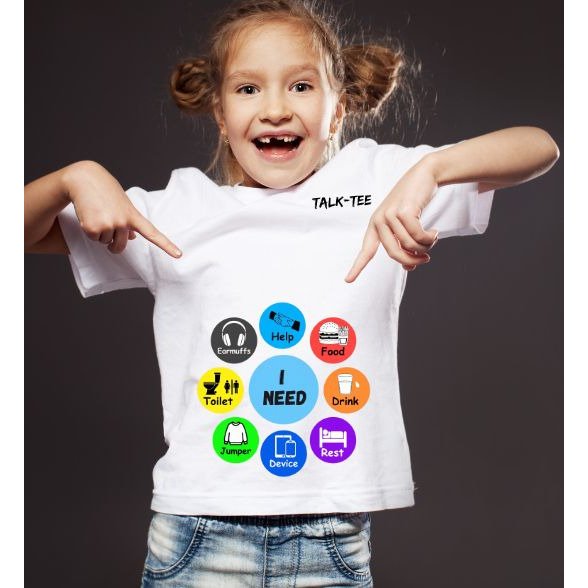
Dots Low-Tech Communication Board T-Shirt
Beyond t-shirts, the Chat-Cap Essentials brings 21 communication icons on a cotton cap, symbols hidden under the peak until communication is needed, then simply removed to reveal the icons to your communication partner. The Dots AAC Hoodie at $79.95 offers the same dot-and-bubble design in a warmer garment for cooler weather.
The real strength of wearable AAC is hands-free communication. A child can play, run, participate in sports, and engage with peers without holding a device. When they need to communicate, the symbols are right there on their body. No setup. No unlocking. No waiting for software to load.
Wearable AAC also addresses a safety concern many families face. The optional Scan2Connect QR code subscription (first 12 months free with purchase) links to a secure, personalised webpage with medical details and emergency contacts.
AAC Tablet Benefits and Limitations in Daily Use
Tablets running AAC software offer capabilities that fixed wearable systems cannot. Speech output is one significant advantage, many people benefit from hearing their words spoken aloud, which can reinforce learning and provide auditory feedback during communication.
Tablets also enable sentence construction. Instead of pointing to pre-set symbols, users can combine words to express ideas that weren't pre-planned. This flexibility is essential for people whose communication needs are complex, creative, or changing. A student might use a tablet to participate in classroom discussions.
The limitations are equally real. Tablets require charging, forget to plug in the device overnight, and it's useless the next morning. They need to be carried, which means they can be left behind, lost, or forgotten.
Tablets are also fragile. A drop from a table can crack the screen or damage the device entirely. For active children or those who may throw objects during frustration, a tablet is a significant financial risk. Repairs or replacements add ongoing costs beyond the initial purchase.
Real-world experience suggests that tablets work best for people who have already developed communication skills and can navigate software interfaces. For early communicators or those with significant motor or cognitive barriers, the complexity of a tablet can actually slow down communication rather than enhance it.
Direct Comparison: Portability, Cost, and Reliability
Portability is where wearable AAC truly shines. You put on your t-shirt or cap in the morning, and your communication tool is with you all day. No backpack required. No risk of leaving it behind.
Tablets require active management. Someone must remember to charge the device, carry it to appointments, and ensure it's accessible when needed. For busy families juggling multiple responsibilities, this extra step can mean the difference between communication happening and communication being unavailable when it matters most.
Cost matters, particularly for families relying on NDIS funding or managing tight budgets. Talk-Tee's wearable AAC t-shirts start at $34.95, with hoodies at $79.95 and caps at $39.95. These are one-time purchases with no ongoing costs. Tablets start higher and often require software subscriptions, apps, or additional accessories.
Reliability is another consideration. Wearable AAC has no moving parts, no batteries to drain, no software to crash. A t-shirt with printed symbols works the same way on day one and day 365. Tablets are sophisticated devices with many potential failure points.
That said, tablets offer something wearable AAC cannot: adaptability. If communication needs change or new vocabulary is needed, you can update a tablet's software instantly. With wearable AAC, you're limited to the symbols printed on the garment.
Can You Use Both Together? A Practical Approach
The strongest communication setup often combines both approaches. A wearable AAC device handles everyday, quick communication and provides a fallback that always works. A tablet offers depth, flexibility, and voice output for situations where more sophisticated communication is needed.
This hybrid approach works particularly well in structured settings like school. A child might use their communication t-shirt throughout the day for social interaction and quick needs. During literacy or communication therapy sessions, they switch to a tablet where a speech and language therapist can work on sentence building, vocabulary expansion, and developing more complex communication skills. The t-shirt keeps communication flowing when the tablet isn't available; the tablet develops communication capacity over time.
At home, the same logic applies. A wearable AAC device supports quick communication during meals, play, and daily routines. A tablet becomes available during dedicated communication practice or when more complex expression is needed. Neither replaces the other; they work together.
For families with NDIS funding, this combination approach often makes financial sense. The lower cost of wearable AAC leaves budget available for a tablet or AAC software. Rather than choosing one or the other, you're building a complete communication toolkit.
Which Option Is Right for Your Situation?
Choosing between wearable AAC and tablets depends on answering a few practical questions honestly.
Choose wearable AAC if: You need communication that's always accessible, without setup or charging. Your communication needs are relatively consistent and can be addressed with a fixed set of symbols.
Choose tablet AAC if: You need flexible, customisable vocabulary that can change frequently. Voice output is important for learning or preference. You're building communication skills and need a tool that grows with the user.
Choose both if: You want maximum flexibility and reliability. You're managing communication across multiple settings (school, home, therapy, community). You have NDIS funding that allows for multiple tools. You want a fallback option if one tool is unavailable.
The real answer to "is wearable AAC better than tablets?" is this: better depends on your life, your needs, and what you'll actually use consistently. A tablet gathering dust on a shelf isn't helping anyone.
Talk-Tee's approach prioritises accessibility and reliability. Our wearable AAC tools are designed to stay with you, work without batteries or software, and give you a voice in any situation. For many families, that's exactly what they need.
The choice is yours, but make it based on how you'll actually live and communicate, not on what sounds technically impressive.
Communication shouldn't require perfect conditions or technical expertise. Our wearable AAC range, from the Freedom AAC-TEE to the Chat-Cap Essentials, puts communication where it belongs: always with you. Explore our full range and find the wearable AAC solution that gives you the voice you deserve. SHOP now and start communicating with confidence.
Frequently Asked Questions
Is wearable AAC better than a tablet for everyday communication?
Neither is universally better—it depends on your situation. Wearable AAC like the Freedom AAC-TEE ($34.95) is always accessible, requires no charging, and works in any environment. Tablets offer more vocabulary and customisation but need power, can be forgotten, and may feel cumbersome for young children. Many families find wearable AAC works best for quick, frequent communication throughout the day, while tablets suit longer conversations or when more detailed expression is needed.
What are the main advantages of wearable AAC compared with a tablet?
Wearable AAC has several practical advantages: it's always with the person (no device to lose or forget), requires no battery or charging, works in any weather or environment, and costs significantly less—Talk-Tee wearable options start at $34.95. There's no learning curve with familiar symbols, and communication happens instantly by pointing. Tablets, by contrast, can fail, drain batteries, and may be too large or heavy for younger children to carry comfortably.
Can wearable AAC and tablets be used together in the same communication plan?
Yes, and many families do combine them effectively. Use wearable AAC like the Dots Low-Tech Communication Board T-Shirt ($34.95) for quick, everyday needs—food, toilet, help—and a tablet when the person needs more vocabulary or wants to have longer conversations. This layered approach gives flexibility: wearable AAC is always there as a backup, and the tablet handles more complex communication when time and context allow. Speech therapists often recommend this combination.
How can wearable AAC help someone communicate in an emergency?
Wearable AAC clothing like Talk-Tee products can be paired with the Scan2Connect QR code subscription (first 12 months free with purchase), which links to a secure personalised webpage containing medical details, emergency contacts, and communication tools. When someone wearing the shirt is in distress, a stranger, teacher, or emergency responder can scan the QR code to understand the person's needs, medical conditions, and how to contact their family—all without requiring the person to speak or use a device.